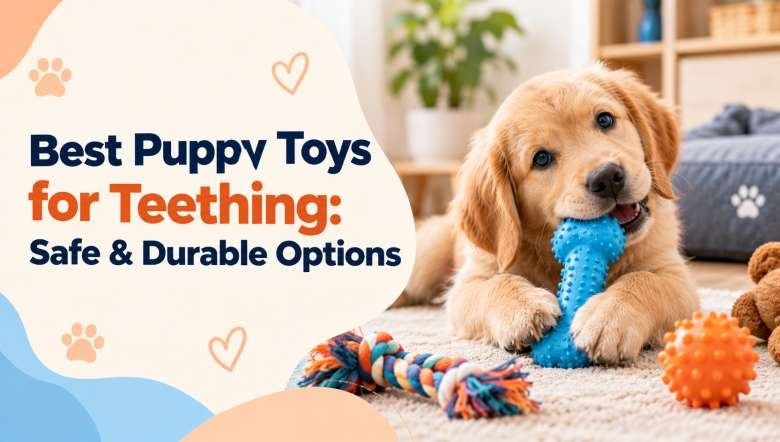
Puppy teething can bring chewing, mouthing, and a strong desire to explore everything with the mouth. Choosing the best puppy toys gives young dogs an appropriate outlet while protecting household items. The right toy should match your puppy’s age, size, chewing style, and developmental stage.
Why Puppies Need Teething Toys
Puppies naturally investigate their surroundings by chewing, and teething can make this behaviour more noticeable. Appropriate chew toys provide a safer alternative to shoes, furniture, cables, and other household objects while giving puppies an activity they can explore.
The goal is not to stop chewing completely but to teach your puppy what is appropriate to chew. Keep several suitable toys available and redirect your puppy calmly whenever it chooses an inappropriate object. Rewarding the correct choice can make this part of pet training easier.
Soft Rubber Teething Toys
Soft but durable rubber toys are popular choices for puppies because they can provide an appropriate chewing surface without being excessively hard. Some are designed with textures or grooves that make them more interesting and can be filled with suitable treats.
Choose puppy-specific rubber products rather than extremely hard chew items intended for powerful adult chewers. Inspect the toy regularly for cracks, chunks, or damage, and remove it immediately if pieces begin breaking away.
Puppy-Safe Rope Toys
Rope toys can provide chewing and interactive play opportunities, particularly when used for gentle games with a pet parent. They can also help introduce puppies to controlled tug activities when the game is structured appropriately.
However, rope fibres can become loose through repeated chewing. Do not leave a heavily damaged rope toy available for unsupervised chewing. Replace it when strands begin separating or the toy becomes significantly worn.
Treat-Dispensing Puppy Toys
Treat-dispensing toys can combine chewing, exploration, and problem-solving. Filling an appropriate toy with a small amount of your puppy’s regular food can turn mealtime into an engaging activity while reducing reliance on additional high-calorie treats.
Start with an easy-to-use toy so your puppy understands how it works. If the challenge is too difficult, frustration can replace enrichment. Gradually increase difficulty as your puppy becomes more confident and learns how to interact with the toy.
Puppy Teething Rings and Textured Toys
Textured teething rings can provide different surfaces for puppies to explore with their mouths. Some designs are flexible and specifically intended for young dogs, making them useful additions to a puppy’s toy rotation.
Avoid choosing a toy simply because it has the most aggressive texture. A puppy’s gums are still developing, so excessively hard or sharp surfaces may be unsuitable. The toy should offer engagement without causing visible discomfort or injury.
Avoid Extremely Hard Chews
Hardness is not the same as durability. Extremely hard objects can pose risks to a puppy’s developing teeth, particularly when the puppy repeatedly bites down with force. A toy that appears indestructible may not necessarily be appropriate for teething.
Avoid giving puppies inappropriate household objects such as stones, hard plastic items, or other materials not designed for canine chewing. When in doubt about a particular chew, ask your veterinarian for guidance based on your puppy’s age, teeth, and chewing behaviour.
Choose Toys According to Puppy Size
A small-breed puppy and a large-breed puppy have different mouth sizes and chewing abilities. Select toys designed for your puppy’s current size rather than buying a large toy simply because your puppy will eventually become bigger.
Reassess toy size as your puppy grows. A toy that was appropriate at eight weeks may become easier to swallow several months later if the puppy has grown substantially. Regularly review the toy collection instead of assuming every toy remains suitable.
Use Teething Toys During Pet Training
Teething toys can become useful tools during pet training. If your puppy bites hands during play, calmly redirect the mouth toward an appropriate toy. When the puppy engages with the toy instead, reward the behaviour with praise or another suitable reinforcement.
Consistency is important. Everyone in the household should follow the same approach so the puppy does not receive conflicting messages. Avoid rough punishment for normal puppy chewing; teach the puppy what it should chew instead.
Choosing the Right Toys for Your Dog
Toys are more than just a source of entertainment for dogs. The right toys can provide mental stimulation, encourage physical activity, support healthy chewing habits, and help reduce boredom when dogs spend time alone. When choosing the best dog toys, pet parents should consider their dog’s age, size, chewing behaviour, activity level, and individual preferences. A toy that works well for a small puppy may not be suitable for a large or strong chewer.
Keep Toy Play Separate From Aggressive Games
Interactive play can be healthy, but puppies should learn appropriate boundaries. If tug games become overly intense, pause the activity and allow the puppy to settle before restarting. Teach simple cues such as “drop” or “leave it” through positive reinforcement.
The objective is to make toys a predictable part of play rather than encouraging uncontrolled grabbing. Well-managed toy play can support both mental stimulation and early pet training.
Clean Puppy Toys Regularly
Toy hygiene is an important part of pet care, particularly when toys are chewed frequently. Wash toys according to their material and manufacturer’s instructions. Remove food residue from treat-dispensing toys because leftover food can spoil or develop unpleasant odours.
Keep separate storage areas for clean and used toys. If a toy cannot be cleaned effectively or develops persistent damage, replace it. Clean toys can support a more hygienic household routine alongside feeding and grooming.
Puppy Toys and Pet Grooming
Puppies also need to become comfortable with handling, brushing, bathing, nail care, and other pet grooming routines. Toys can sometimes help create positive associations with calm handling when used appropriately.
For example, a puppy can enjoy a suitable chew toy while briefly practising calm handling of its paws or coat. Keep these sessions short and gentle. Never distract a puppy with a toy to force prolonged handling if it is frightened or uncomfortable.
How Pawlair Fits Into Puppy Care
At Pawlair, a puppy’s daily routine can be viewed as a combination of appropriate nutrition, safe play, exercise, pet training, socialisation, veterinary care, and pet grooming. Teething toys can support this routine by giving puppies suitable opportunities to chew and explore.
The best toy is not necessarily the most expensive or most durable product. It is the one that matches your puppy’s developmental stage, size, chewing behaviour, and supervision level while remaining in good condition.
FAQs
1. What are the best puppy toys for teething?
Soft, puppy-specific rubber chew toys, appropriately sized textured toys, and suitable treat-dispensing toys can be useful options. Choose products according to your puppy’s age, size, chewing behaviour, and the manufacturer’s safety guidance.
2. Are hard chew toys safe for teething puppies?
Extremely hard chews may not be appropriate for puppies because developing teeth can be damaged by excessive hardness. Choose puppy-specific products and ask your veterinarian about any chew that seems unusually hard or rigid.
3. How often should I replace puppy chew toys?
There is no fixed replacement schedule. Inspect toys frequently and replace them when they develop cracks, loose pieces, sharp edges, separated fibres, damaged seams, or other defects that could create a swallowing or injury risk.
4. Can teething toys help with puppy training?
Yes. Appropriate toys can help redirect chewing from hands and household objects toward acceptable items. During pet training, reward your puppy for choosing its toy and keep household rules consistent across family members.
5. How many toys should a puppy have?
There is no required number. A small rotating selection of appropriately sized chew, interactive, and play toys is usually more useful than providing a large collection at once. Rotate toys regularly and remove anything that becomes damaged.